Concrete Patio Arlington TX: Fall Prep for a Slab That Lasts
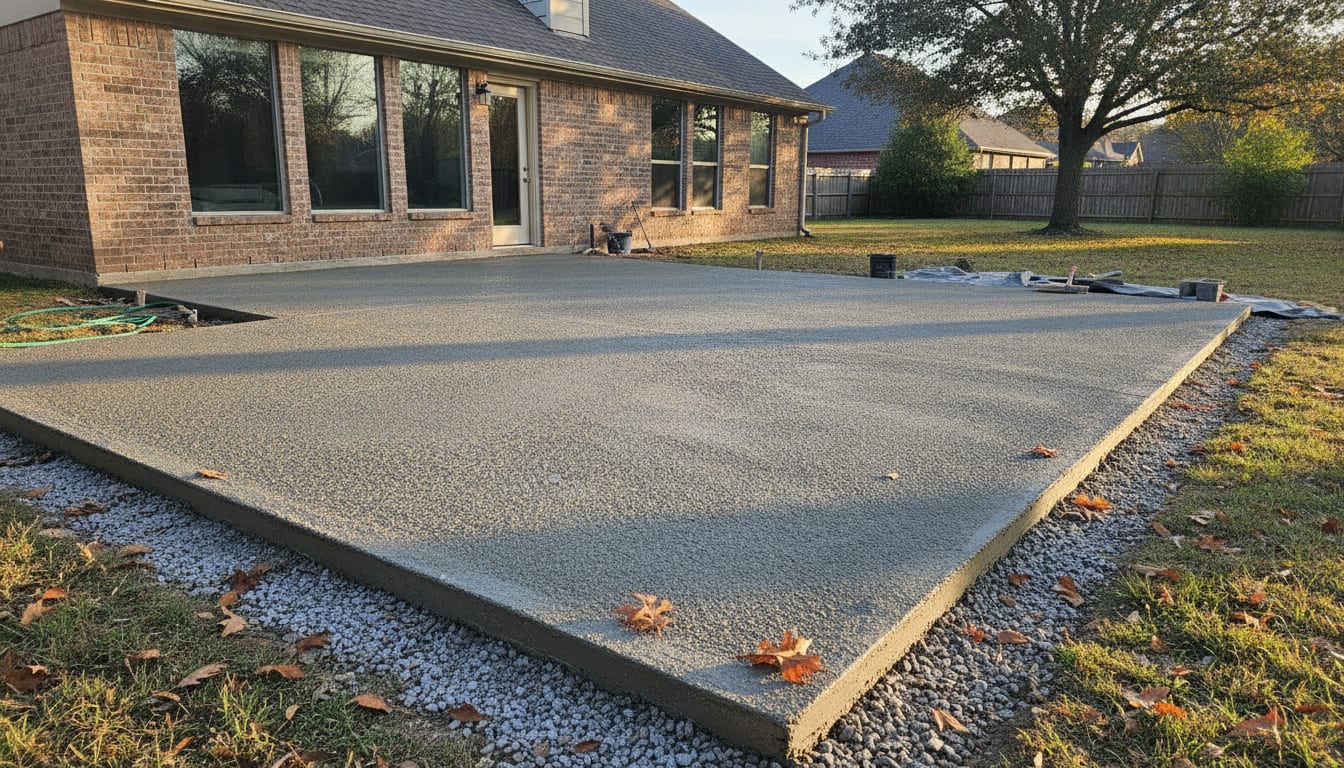
Planning a concrete patio in Arlington TX? Learn why fall is ideal and what prep determines a slab that won't crack on DFW's clay soil.
Fall in North Texas is about as good as it gets for pouring concrete. The ground isn't baked hard from a hundred-degree summer, it isn't soaked from spring storms, and the mild days give a fresh slab time to cure without the surface drying out too fast or freezing overnight. If you've been thinking about a concrete patio in Arlington, TX, this is the window to actually get it scheduled instead of just pinning it to a board.
Why the Ground Matters More Than the Concrete
Most of the Metroplex sits on expansive clay soil, and that's the part people underestimate. This clay swells when it's wet and shrinks when it's dry, which is why you'll see doors stick in one season and not another, or a crack in the drywall that keeps coming back no matter how many times it gets patched. A concrete slab poured on top of that same soil is just as exposed to the movement underneath it. A patio, walkway or driveway section that looks fine on day one can start showing cracks a year or two later if the base under it wasn't prepped to handle that seasonal swing.
That's why the prep work matters more than the pour itself. Proper excavation depth, a compacted base material, control joints placed where cracking is actually likely to happen, and reinforcement sized to the job all go into whether a slab lasts or starts failing early. None of that shows up in a photo of the finished patio, but it's the whole reason one slab holds up for decades and another one doesn't.
Patios, Walkways and Driveway Sections
Concrete work shows up in a few different forms around a typical DFW property. A patio slab is often the first piece, sometimes on its own and sometimes as the foundation for a patio cover, pergola or screened porch going in over it. Walkways tie a backyard together or connect a driveway to a front entry. Driveway sections come up when a slab has settled unevenly, cracked at the seams, or just needs extending for an added garage or parking pad. We also pour footings and slabs that support additions and outbuildings, since that structural concrete has to be right before framing ever starts.
Finishing Touches That Change How It Lives
A broom finish is standard for a reason - it gives traction around a pool deck or back door when it's wet. Stamped or stained concrete can dress up a front walkway or patio without the cost of pavers or natural stone. If the patio is going to sit under a cover, the finish and the drainage slope both need to be planned together, so water moves away from the house rather than pooling under the roofline.
Why Fall Is the Right Call
Hot summer days push surface temperatures high enough that curing concrete can dry too fast and crack before it ever gets to full strength. Heavy spring rain can delay a pour altogether or saturate the base you just compacted. Fall splits the difference - cool enough nights, mild enough days, and a good stretch before the first hard freeze. If a patio cover, pergola, or outdoor living space is on your list for next spring, pouring the concrete now means the hard part is already done when the weather turns nice again.
One Contractor, Start to Finish
Anaya's Touch Renovations is a family-owned renovation contractor based in Arlington, serving Arlington, Grand Prairie, Irving, Coppell, Colleyville, Richardson, and up into Plano, Frisco and McKinney. Eduardo Anaya has run it since 2016 and still does the estimating and runs every job himself - what he calls A to Z renovation services, meaning one contractor handles the concrete, the patio cover or outbuilding that goes with it, and anything else the project needs, instead of juggling separate crews. He's rated 5.0 from 38 reviews on Google, which is worth a read if you want to see what past customers say about the process. Estimates are free, on site, with no obligation.
Frequently Asked Questions
Do I need a permit for a concrete patio in Arlington?
It depends on the size, location and whether it ties into drainage, grading or an existing structure. Smaller standalone patios sometimes don't need one, but anything attached to the house, part of a driveway, or paired with a patio cover often does. Eduardo can walk through what your specific project needs when he comes out for the estimate.
Why does my concrete keep cracking even after it's patched?
In North Texas, that's almost always the clay soil underneath moving with the seasons rather than a problem with the concrete itself. A patch on a slab that's still shifting usually only lasts a season or two. If you're seeing the same crack return again and again, it's worth having someone look at what's happening below the surface rather than just resurfacing it again.
Does a concrete contractor need a state license in Texas?
Texas licenses plumbers and electricians, but it does not issue a state license for general contractors, remodelers or concrete work. That means the right questions to ask are about insurance, a written scope of work, permits, and references - not a license number that doesn't exist for this trade. Anaya's Touch carries insurance and works only with licensed subcontractors for the plumbing and electrical work Texas does regulate.